Authors: Juan Su, Thomas Petenzi, Grégory Barbillon, Catherine Debiemme-Chouvy, Laure Fillaud, Alain Pailleret, Hubert Perrot
Journal: Nano Select
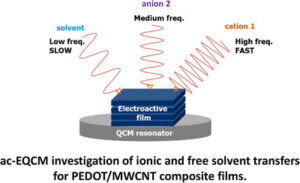
Abstract: Binder-free electrodes are critical for advancing supercapacitor performance. Here, we explore the development of multi-wall carbon nanotubes (MWCNTs) electrodes for supercapacitors by replacing conventional non-conductive polymer binders, such as poly(vinylidene fluoride-co-hexafluoropropylene) (PVDF-HFP), with a conductive polymer, poly(3,4-ethylenedioxythiophene) (PEDOT). PEDOT/MWCNT composite films were synthesized and characterized in an aqueous medium using an electrochemical quartz crystal microbalance (EQCM) and an advanced ac-electrogravimetric technique to investigate their charge storage mechanisms and ionic transfer kinetics. Compared to MWCNTs/PVDF-HFP and pure PEDOT films, the PEDOT/MWCNT composite demonstrates enhanced electrochemical performance, with improved ion concentration and reduced interfacial resistance. The EQCM analysis reveals distinct mass transfer behaviors, highlighting the role of anions, cations, and free water molecules at the interface of electrodes. Ac-electrogravimetry investigation further identifies the kinetics of ion transfer and the relative concentration of each species, showing that the composite film facilitates efficient charge storage. This work provides a new insight into understanding the interfacial behavior of binder-free PEDOT/MWCNT electrode.